A Conversation Between Two People

A Mindfulness story

They met on the back porch just after sunrise, the air was still cool enough to feel clean. He stood there with a mug warming his hands, watching the steam rise as if it might offer some kind of direction.

His old friend sat beside him, the kind of man who didn’t need to fill silence to feel present. He’d lived enough life to stop performing it. He sipped his coffee slowly, like time wasn’t something to chase anymore.

“You’re quiet this morning,” the friend said.

A small shudder moved through him. “Just thinking.”

“About what?”

He hesitated—not because he didn’t know, but because saying it aloud made it real. “About what it means to live now. After everything. After not being afraid anymore.”

The friend nodded, as if he’d been waiting for that. “Ah. That part.”

“What part?”

“The part where life stops being something you endure and starts being something you have to figure out again.”

He let out a breath he hadn’t realized he was holding. “Yeah. That.”

The friend leaned back, the chair creaking softly beneath him. “When I went through it, I thought something was wrong with me. I thought meaning was supposed to come back all at once. Like flipping a switch.”

“Did it?”

“No,” the friend said, smiling. “It came back like sawdust in morning light. Little pieces drifting around. Barely noticeable until suddenly they were everywhere.”

He looked down at his hands—the calluses, the faint grain lines that never fully faded. “I don’t feel lost anymore. Just… I don’t have words for this. I don’t know what to do with it or how to name it.”

“That’s because you’re not rebuilding the old life,” the friend said. “You’re building the one that fits you now, one that is new and uncharted.”

He frowned. “But how do you know what fits?”

“You don’t,” the friend said. “Not at first. You try things. You pay attention to what feels alive. You let yourself be curious instead of certain.”

He took a sip of coffee. It tasted different—not better or worse, just more noticeable.

“I keep waiting for some big purpose to show up,” he said.

The friend laughed softly. “That’s the old way talking. Purpose isn’t a lightning strike. It’s a conversation. One you have with your days.”

He let that settle, chewing on it the way he did when something landed deeper than expected.

“So what did you do?” he asked.

“I started small,” the friend said. “I asked myself what felt good in my hands. What felt honest in my chest. What didn’t drain me. And I followed that.”

“And that was enough?”

“It was a beginning,” the friend said. “And beginnings are always enough.”

He looked out at the yard—the early light catching on the grass, the dogs moving quietly through their morning rituals, the world waking up without asking anything from him.

“I think I’m ready for that,” he said.

The friend nodded. “I know you are. You wouldn’t be asking these questions if you weren’t already on your way.”

He didn’t say anything after that. He didn’t need to. The morning spoke for both of them—the warmth of the mug, the slow breath, the simple fact of being here without needing a reason.

For the first time in a long time, the question wasn’t why live.

It became how.

And that felt like the beginning of something real.

Later that week, they sat on the porch again, the afternoon light slanting low and warm. He had spent the morning trying to meditate—or something like it—and it had left him more frustrated than calm.

The friend noticed before he said a word.

“You’re carrying something today?”

He exhaled sharply. “I tried sitting this morning. Breath work. Mindfulness. All the things I used to teach. It felt… pointless.”

The friend turned toward him, those clear blue eyes seeing more than he wanted them to. “Pointless how?”

“Like I was pretending,” he said. “Like I was going through the motions of someone I used to be.”

The friend nodded slowly. “Ah. That part.”

He frowned. “You keep saying that!”

“Because it’s real,” the friend said with a knowing smile. “It’s the part where the tools you once taught don’t fit the person you are now.”

He looked down at his hands. “I used to guide people through this. Help them find their breath, their center. And now I can’t sit still for ten minutes without feeling like I’m faking it.”

“Mindfulness isn’t a skill you lose,” the friend said. “It’s a relationship that changes. Like seasons. It’s always there, waiting for you to find a new reason to use it.”

“What does that mean?”

“It means the version of mindfulness you taught came from who you were then as the counselor, the guide, the one who held space for others.”

“And now?”

“Now you’re the one who needs the space,” the friend said gently. “And that changes the practice.”

He swallowed hard. “It feels like failure.”

“It isn’t,” the friend said, each word deliberately. “It’s honesty. You’re not broken. You’re just not who you were when you taught those practices. And that’s okay.”

He let that sink in. It hurt, but in a clean way.

“I keep thinking I should be better at this,” he said. “That I should know how to navigate this. That I should be able to use the tools I taught for so many years.”

“Mindfulness isn’t a tool,” the friend said. “It’s a posture. And right now, your posture is different. You’re not guiding others. You’re learning how to guide yourself.”

He stared out at the dogs sprawled in the shade, the world moving at its own unhurried pace.

“So what do I do?”

“Start where you are,” the friend said. “Not where you were. Not where you think you should be. Just here.”

He closed his eyes for a moment—not to meditate, but simply to feel his own breath.

“It’s strange,” he said. “I used to tell people to meet themselves with compassion. But I don’t know how to do that for myself.”

“That’s because compassion is easier to give than receive,” the friend said. “Especially for someone who spent a lifetime holding others.”

“So how do I learn.”

“The same way you taught others,” the friend said softly. “One breath at a time. One moment at a time. One honest admission at a time.”

He let out a long, natural breath.

And for the first time in a long time, it didn’t feel like he was failing at mindfulness.

It felt like he was finally practicing it.

A few days later, the friend challenged him again.

“You’re hiding,” the friend said.

He blinked. “What.”

“You’re hiding behind the idea that you’ve changed too much to practice what you taught. That you’re too disillusioned, too far gone.”

He looked away, jaw tight.

“You taught people how to meet themselves,” the friend said. “How to breathe through discomfort. How to sit with uncertainty. How to be present in the dark. Now it’s your turn.”

“I don’t trust it anymore,” he said quietly.

“No,” the friend said. “You don’t trust yourself.”

That landed hard.

“You don’t have to teach,” the friend said. “You don’t have to perform. But you do have to show up. For yourself. For this life you’re still living.”

“I’m scared,” he admitted.

“Good,” the friend said. “That means you’re close to something real.”

And something shifted—not loudly, but enough.

Enough to try again tomorrow.

The next morning, he sat on the porch alone. No friend. No conversation. Just him, the dogs, and the quiet.

He closed his eyes. Let his hands rest on his knees. Tried to follow his breath.

It lasted maybe forty seconds.

His mind spun—old memories, unfinished projects, the ache in his shoulder, dinner plans. He sighed, frustrated.

“This used to be easier,” he muttered.

One of the dogs rested her head on his foot, grounding him.

He looked at her, then at the yard. The soft light. The stillness.

And he realized: He wasn’t failing. He was simply different.

The man who once taught mindfulness had been composed, practiced, fluent. This version of him—post-career, post-collapse, post-fear—was raw. Unpolished. But honest.

And maybe that was enough.

So he tried again. Not breath work. Not a body scan. Just sitting.

The dogs. The porch. The ache in his shoulder. The quiet.

He didn’t fix anything. He didn’t perform. He just noticed.

And something shifted—small, but real.

Enough to feel the sun on his face. Enough to hear the birds without naming them. Enough to understand that presence isn’t a technique.

It’s a willingness.

He stayed there a while. Not meditating. Not practicing. Just being.

And when he finally stood, he didn’t feel accomplished.

He felt real.

And that was enough.
Chance Meeting

Chapter 1 Excerpt:

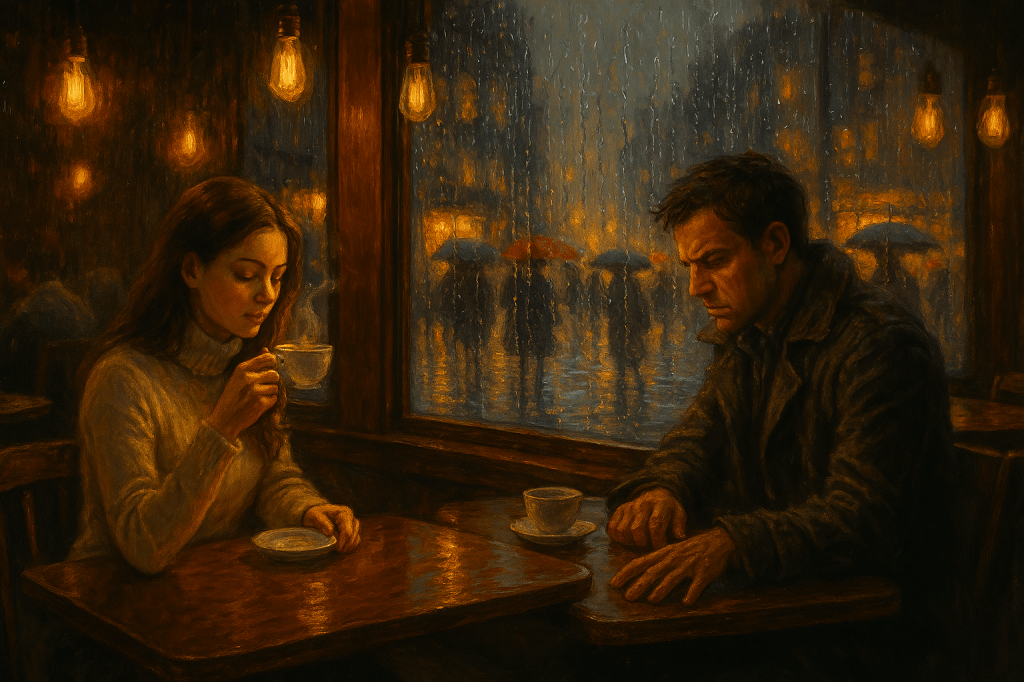
The café’s low murmur felt like a soft blanket wrapped around Mia as the rain drummed a gentle, steady rhythm against the windowpane. Warm pools of amber light spilled from vintage Edison bulbs overhead, illuminating swirling steam above porcelain cups and casting long, flickering shadows across glossy wooden tables. Mia cradled her delicate teacup, inhaling the bright, citrusy scent of Earl Grey mingled with faint undertones of cream. She watched raindrops trace meandering paths down the glass—tiny travelers meeting, parting, then speeding together toward the sill in a liquid dance. Beyond the pane, umbrellas bloomed like black and colorful mushrooms on the slick sidewalk, their owners hustling past in dark coats, each canopy just brushing the next as if an invisible boundary held them apart.

Jordan had entered with the storm still clinging to him. His shoulders were hunched, jaw tight, and every movement carried the sharpness of irritation. The rain had soaked through his coat, leaving him chilled, and the crowded sidewalks outside had felt like an obstacle course of umbrellas and hurried strangers. Even here, in the café’s glow, his mind buzzed with restless static—unfinished tasks, the press of time, the nagging sense that he was perpetually behind. He tapped his fingers against a table, quick and uneven, as though trying to drown out the hum of his own thoughts.

Finding Center, a Mindfulness Novel. 2025

saturation

The level of hatred is palpable. I find tears fall for no reason most days. Lost sorrow fills my heart. What I find is that if I do not watch the news, if I limit my social media exposure, and focus on the moment and how life is right in my own community, the sorrow is less. Please understand that I am not burying my head in the sand regarding the state of this country and the world. I suggest that we understand our saturation level for absorbing negativity and step away from the source(s) from time to time to maintain our sanity and keep our hearts pure. Breathe slowly, remain faithful to the love that resides within.

Love & community

The country you live in sucks. Conversely, the country I live in is great. Sadly, it is the same country. Where you see dangerous illegal immigrants and lawlessness, racial disparity, and ‘white’ racism, I see love and commonality. Where you see hatred and division, I see love and community. Whether it is based on your religion or the political leader you choose to worship and follow, I see a person who lives with hatred and division in their heart. The simple fact is that you can either live with love in your heart or with hatred. The two can not reside together and be identified as true. Your love for one person is not complete and pure if you have hatred for another person. It truly is a shallow existence to do so.

how to live with love in a world of hatred and loathing

“…one cannot live with love and hatred in one’s heart…”

Living with Love in a World of Hatred and Loathing

In a world that often seems filled with hatred, division, and loathing, choosing to live with love is both a radical act and a profound necessity. The challenge is not to ignore the darkness but to respond to it with light—to cultivate love within ourselves and to extend it outward, even when it feels difficult.

The Foundation of Loving Oneself

Living with love begins within. Self-love is not selfishness; it is the bedrock of emotional resilience. When we treat ourselves with kindness, patience, and understanding, we establish a foundation that enables us to face the world’s challenges without feeling overwhelmed. Self-compassion helps us recover from setbacks and protects us from the corrosive effects of external negativity.

Empathy and Understanding

Empathy is the bridge that connects us to others. In a world where people are quick to judge and slow to forgive, choosing empathy can help dissolve barriers and foster deeper connections. By striving to understand others’ perspectives—even those with which we disagree—we create space for dialogue and reconciliation. Empathy allows us to see the humanity in everyone, making it easier to respond with love rather than react with anger or fear.

Setting Healthy Boundaries

Living with love does not mean tolerating abuse or allowing others to mistreat us. Setting healthy boundaries is an act of self-respect and love. By clearly defining what we will and will not accept, we protect our emotional well-being while still showing compassion for others. Boundaries help us maintain our integrity and prevent resentment from taking root.

Acts of Kindness

Love is often best expressed through action. Small acts of kindness—a smile, a listening ear, a helping hand—can have a profound impact. These gestures ripple outward, creating a more positive environment and inspiring others to do the same. Kindness is a powerful antidote to hatred and loathing, reminding us of our shared humanity.

Focusing on What We Can Control

We cannot eliminate all the hatred in the world, but we can control our own thoughts, words, and actions. By choosing love in our daily interactions, we contribute to a culture of compassion and respect. This focus empowers us to make a difference, however slight, in our immediate circles.

Surrounding Ourselves with Positive Influences

The people and environments we surround ourselves with shape our outlook. Seeking out positive influences—such as supportive friends, uplifting communities, and inspiring media—helps us stay grounded and hopeful. Positive environments nurture love and provide a refuge from negativity.

Forgiveness and Letting Go

Holding onto anger or resentment only harms us. Forgiveness—for ourselves and others—frees us to live with more love and less bitterness. Letting go of grudges allows us to move forward with an open heart, ready to embrace new possibilities.

Practicing Gratitude

Gratitude shifts our focus from what’s wrong to what’s right. By regularly reflecting on what we’re thankful for, we cultivate a sense of abundance and joy. Gratitude opens our hearts to love and helps us appreciate the beauty in everyday life.

Staying Hopeful and Inspired

Hope is a vital companion on the journey of living with love. Reading stories of hope, watching inspiring films, or listening to uplifting music reminds us that love is always possible, even in the most challenging times. Hope sustains us and fuels our commitment to making the world a better place.

Being a Light of Reason and Understanding for Others

By living with love in our hearts, we become beacons of hope and inspiration. Our example can encourage others to choose love over hatred, compassion over indifference. In this way, the love we cultivate within ourselves has the power to transform not only our lives but also the world around us.

Living with love in a world of hatred is not easy, but it is possible. It begins with loving oneself first and extends outward through empathy, kindness, and forgiveness. By focusing on what we can control and surrounding ourselves with positive influences, we can sustain love even in the face of negativity. It is up to us, as individuals and as communities, to choose love as a powerful act of resistance against hatred—one that has the potential to heal, unite, and inspire. In a world that often feels divided, love is the force that can unite us.

The State of the union

My heart is filled with so much sorrow and pain. In the past, when I faced hatred and division, it usually was several degrees away from me. I witnessed hatred in the news, and in places separate from me. But today hatred has come home to my heart in a very personal way. The division of people based on political views has permeated deep into our global society to the point of division in communities and deeply into families.

This country has faced division and hatred before and has always found a delicate balance between love and violence. The last time this country was so divided, brothers were killing brothers over the right to own another human being. I had believed we had grown and come along way from that level of hatred. Today, I do not believe we have.

I had recently watched a commencement speech from a recent Harvard graduate that brought tears to my eyes and sorrow to my heart, as her words sank deeply into my soul. She is so full of love and hope for her future and the future of her generation, but that hope and love has become tempered with fear and sadness over the level of hatred and ignorance the government has presented and acted on recently.

I sat watching her and listening, knowing there are many who would wish to deport her, or worse, imprison her for her words. We have descended into a world of abject hatred and the inability to allow critical thought and understanding. My heart is filled with sorrow and pain, and I cannot fathom where this will all end. I pray for love and I pray for peace and understanding.

CASA MCCOY Photo 2023

LOVE

For I am not a Christian

Having given up that title many years ago

When witnessing the hatred and anger possessed in the name of Christ

I wept and began my search for true spirituality

Upon being gifted the book The Tao te Ching

I slowly began to understand the simplicity

The simplicity of the purity of true faith

It is said that God is love

But that statement is too simple for the complicated mind

God IS Love, Love IS God

The simplicity is

One chooses to live with Love

Act with Love and treat everyone with Love

To consider one as an enemy

You, yourself becomes an enemy

Life is simple

It is your choice to complicate it

or not.

Love.

NO WORDS

No words were spoken this time

She left those words in another place

In another time

Are thoughts words?

She thought

A car slowly passed by her kitchen window

The drone of the tires causing a lull in her thoughts

Her words

No words were spoken

Because all was said and he was no longer there

She smiled quietly to herself

So this is what peace feels like

She thought with her words silent and still

IS Evil a human creation?

having a conversation with a friend, he asked if i believe in a God. I said not in the terms most have a belief. hen then asked if I believed in good versus evil, as in God versus Satan. I stated that it is my belief that all of this are creations by mankind. If one looks at nature itself, there is on good or evil. Nature exists within its own set of rules and laws, so to say. there is a cod of conduct in the natural world, that we as humans willingly ignore on most occasions.

give as an example the savagery of wildlife, animals killing other animals. this is by rule of need. most often done for the need to eat or for territorial protection. good versus evil does not come into play in nature. the balance of life and death allows for nature to continue in equal measure. humans, on the other hand has the ability to think and reason. this, by any reasonable thought, would preclude that we as a species, would be able to govern ourselves in accordance to the laws of nature and maintain a habitable planet for which all life can survive and thrive.

but this is not the case. for one glaring example humans have completely run over nature and its laws and have systematically destroyed the very planet necessary for its survival. this glaring case is that humans possess an intense and destructive desire that no other species holds, greed. as the Merriam-Webster dictionary states: GREED: a selfish and excessive desire for more of something (such as money) than is needed. The battle between good and evil is indeed a human creation and a God or the antithesis of such is solely within the hearts and minds of the human race.

God help us!

anon

The breaking is so very subtle, it happens in quiet moments. It happens with the unexpected picture or a word overheard. I question myself, how many breaks can a heart take before it completely falls apart? Sometimes I look toward tomorrow with hope. And sometimes I look toward tomorrow with sadness and fear. What if, what if, what if? There are moments I can actually feel the break. Sometimes it is like a dull throb from behind my chest.

Sometimes it is a sudden sharp pain that stumbles my step and causes me to bow my head as a tear forms in the corner of my eye. I will await your call, your message, your understanding. Today the tears come hard. Today the tears come through heavy sobs and a shuddering body. I try hard to hold onto what I remember of love and the gentle caress of its touch. I will continue to wait in hope and more importantly, in love.