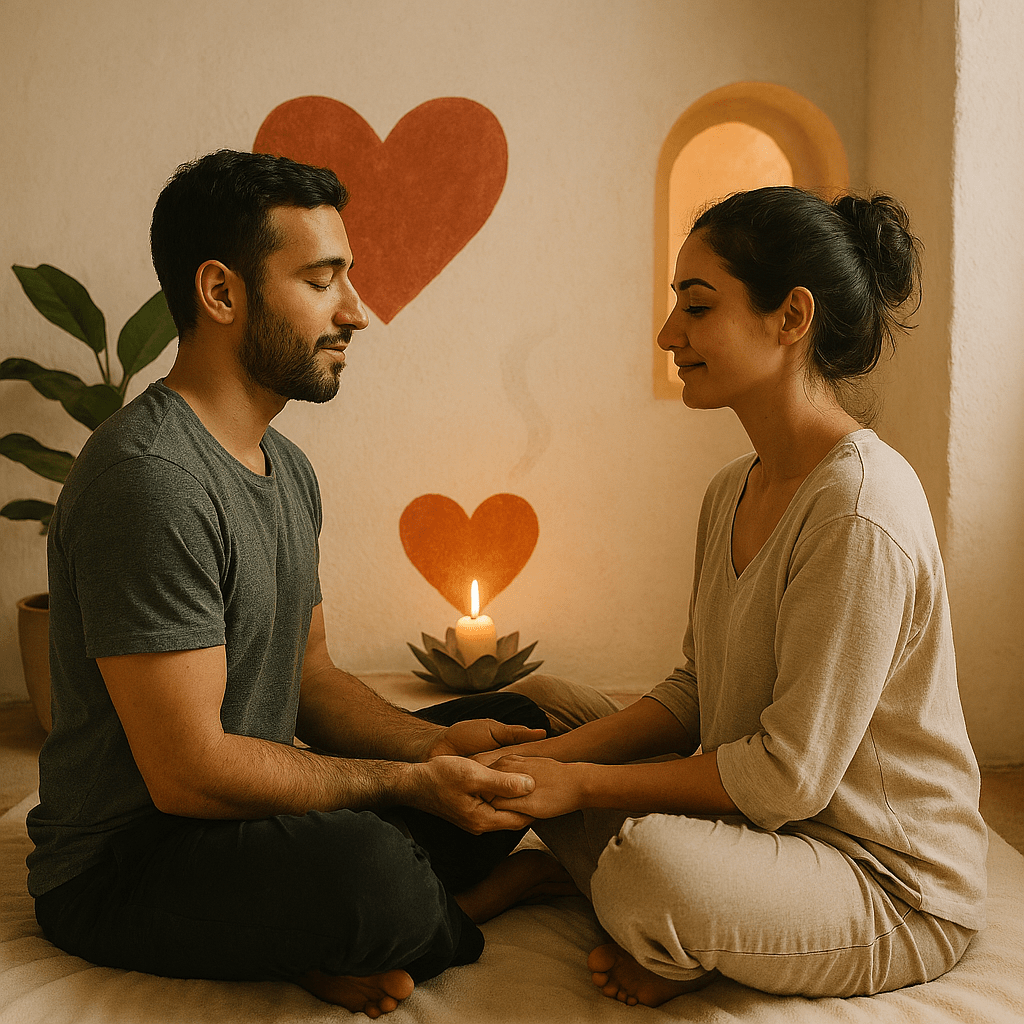
Love and mindfulness are often treated as if they belong to different worlds, one in the realm of feeling, the other in the realm of attention. But in our true lived experiences, they lean toward each other. They keep finding their way back into the same room. When you sit with them long enough, you begin to see that each reveals something essential about the other.
Mindfulness is the clearing of unnecessary inner dialog and chatter. It is the softening of our inner weather, the loosening of the grip of control. It is the willingness to meet the moment without trying to bend it to your will. When that softening happens, love can move again. Not the sentimental kind, not the desperate grasping kind, but the quiet, directional love that knows how to breathe with ease and grace. Mindfulness doesn’t create love, but it removes the debris that keeps love from being truly felt.
And love, in turn, gives mindfulness its orientation. Without love, mindfulness can become a technique, a way of quietly stepping back and hovering above your own life. But when love is present, your attention becomes a form of care. It becomes a way of tending to what is real. Love asks your awareness to be warm, to be honest, to be willing to stay. Mindfulness keeps that warmth from drifting into fantasy or fear. Together they form a presence that is both clear and generous.
Mindfulness also keeps love from dissolving into longing or projection. Love, left unchecked, can drift into stories about what should be or what might have been. Mindfulness brings love back to the ground. It holds the simple curiosities of what is here I need to attend to. What is needed. It doesn’t diminish love; it simplifies it. It lets love be love, not wishfulness.
And love keeps mindfulness from becoming an escape hatch. It refuses the version of mindfulness that floats above feeling. Love insists on contact with the person in front of you, with the truth of the moment, and with the ache that asks to be witnessed. Love pulls mindfulness back into the relationship, reminding us that presence is not a retreat but a way of being with the world.
Together, they create a way of meeting sorrow that is neither overwhelmed nor withdrawn. Mindfulness allows sorrow to be seen without being swallowed. Love allows it to be held without being fixed. Mindfulness says, “This is what is here.” Love answers, “And I will not turn away.” This is the heart of accompaniment, the place where presence and ache sit side by side, and neither one trying to outrun the other.
In the end, love is the direction and mindfulness is the discipline. Love points the way. Mindfulness keeps our feet on the path. Love is the intention; mindfulness is the practice. When they move together, they create a way of being, steady, warm, and deeply human.

 The Journey of a thousand miles